UChicago Pulls AI Out of the Classroom
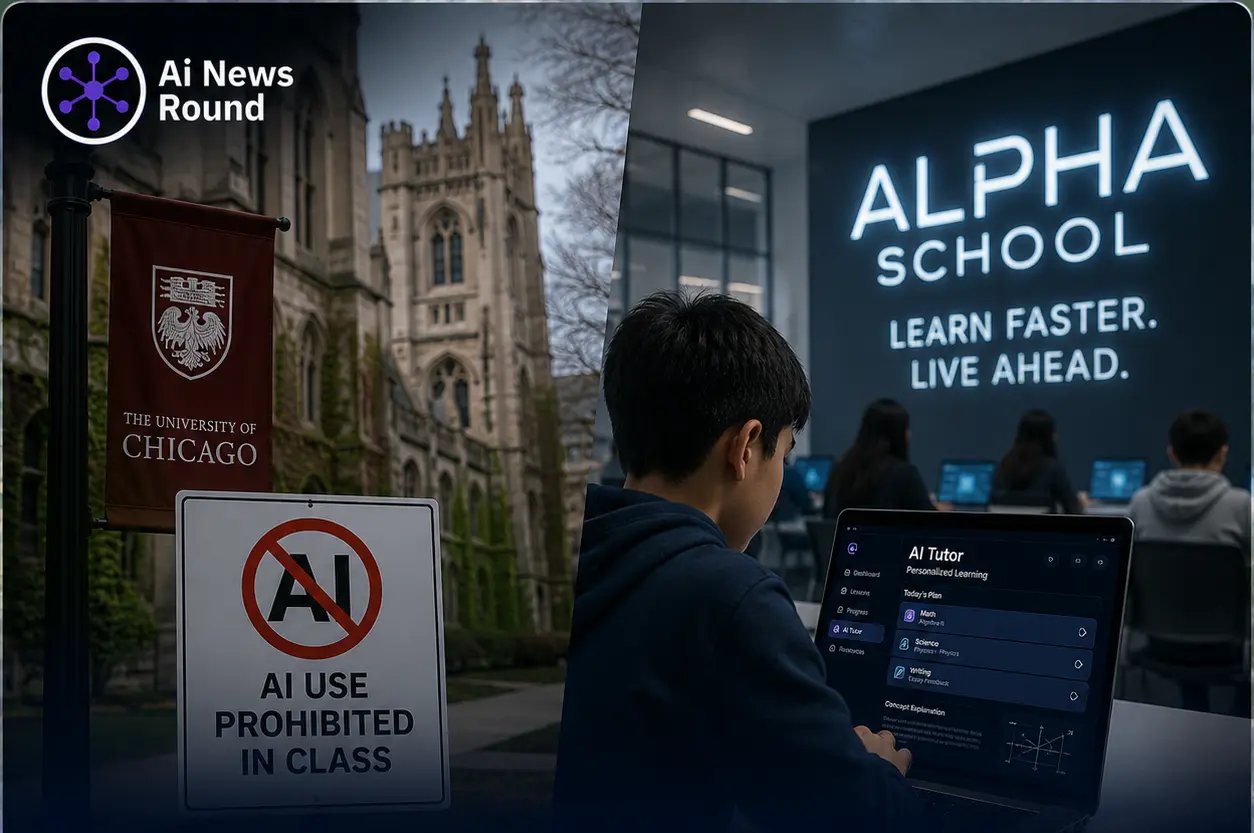
The University of Chicago's Social Sciences Division announced that, starting this fall, its undergraduate Social Sciences Core sequences will ban AI tools, laptops, phones, smartwatches, wearables, and recorded lectures. All assignments in these courses must be completed without AI assistance. The ban applies to undergraduate core sequences specifically, not graduate courses, and faculty retain the ability to approve narrow exceptions for tasks like dataset analysis or citation research; students with documented disabilities keep access to AI-based accommodations.
Division head Jenny Trinitapoli framed the goal as teaching students "to read, write, and think without" reliance on artificial intelligence, protecting independent thinking and close engagement with material unmediated by technology. The policy follows a similar move by UChicago's Law School in July, part of an initiative the school calls "Rethinking Legal Education in the AI Era." Law dean Adam Chilton explained the reasoning behind that earlier policy in similar terms: "We think that kind of exchange should happen" without being "intermediated by machines." The rollout has drawn some pushback, prompting the university to clarify explicitly that disability accommodations involving AI would not be restricted by the new policy.
Alpha School Is Betting the Opposite Way
At the other end of the spectrum, Alpha School — which uses AI software in place of traditional teaching for core academic subjects — is expanding from roughly a dozen campuses in California, Texas, and Florida to approximately 50 campuses for the 2026 school year, opening in 27 markets including Atlanta, Boston, and Chicago. Its New York City campus alone is set to grow from 22 to 160 students.
Alpha's model has students spend up to two hours a day on AI-driven software covering core subjects, with the remainder of the school day devoted to skill-building workshops led by "guides" — staff who earn at least $100,000 annually but are not licensed teachers and are tasked with motivating and coaching students rather than delivering traditional instruction. Tuition runs $45,000 to $75,000 a year. CEO MacKenzie Price argues the model actually "reduces screen time and increases human interaction" compared to conventional schooling, describing Alpha as "one of probably the most talked about schools in the country right now." Not everyone is convinced: Penn State education professor Gerald LeTendre has cautioned that the model risks "conflating teaching and tutoring," arguing the two are distinct activities, and that "AI tutoring can help, but it has to be within an atmosphere where there's deep human contact with a highly qualified teacher." His preferred alternative is training existing teachers to use AI well rather than restructuring schools around replacing them.
Two Institutions, Two Bets, No Consensus
Taken together, these aren't just two schools making different operational choices — they represent genuinely opposite theories about what AI does to learning. UChicago's position is that meaningful thinking and writing require the friction of doing it without AI assistance, at least during the specific formative core-curriculum years. Alpha School's position is that AI-driven instruction, properly structured, can outperform a fully teacher-led classroom on both time efficiency and person-to-person coaching quality. Both are operating on conviction and early results rather than settled evidence, and the discipline-specific and cost differences (a highly selective research university's writing-intensive core sequence versus a $45,000-75,000-a-year private school model) mean neither result generalizes cleanly to the other's context, let alone to public education broadly.
What It Means for You
If you're making AI-adoption decisions in any learning or training context — corporate onboarding, internal upskilling programs, educational products — this pair of stories is a useful reminder that "does AI help learning" is the wrong-grained question. UChicago and Alpha School are both making specific, defensible bets tied to particular goals (protecting unmediated critical writing versus maximizing personalized pacing and coaching time), and the right answer likely depends heavily on what specific skill or outcome you're optimizing for, not on a general verdict about AI in education.