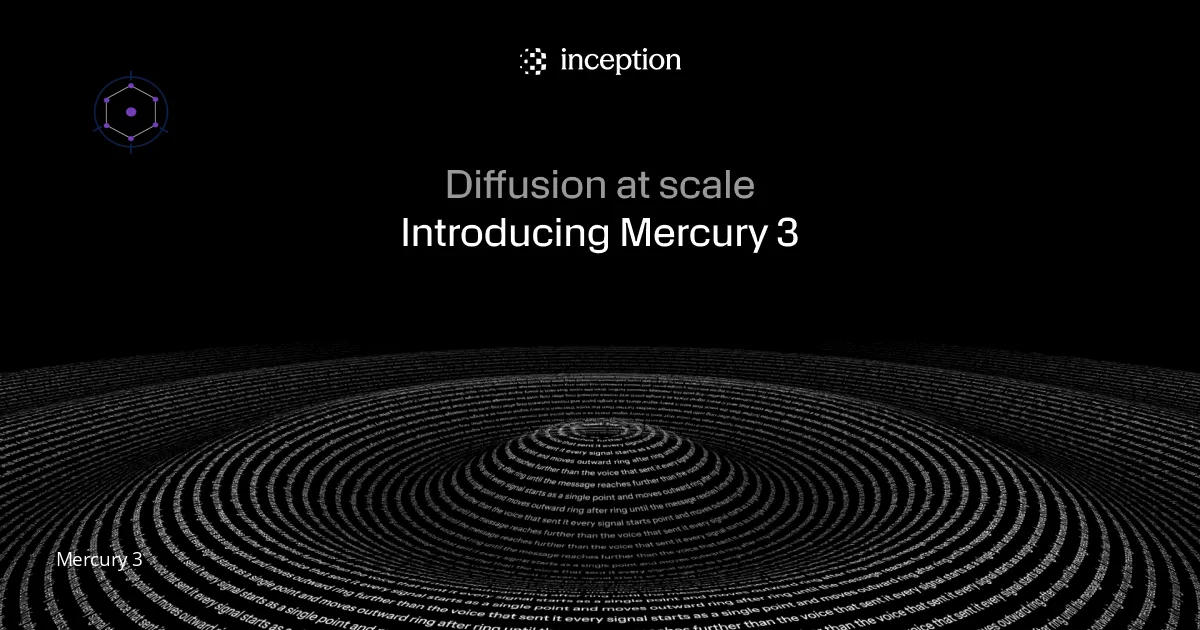
Inception Labs has released Mercury 3, the newest version of its diffusion language model, and the pitch is simple: answers at more than 1,000 tokens per second, a 1 million token context window, and a price that starts at $0.20 per million input tokens. The company announced the model in a post on its blog dated 19 October 2026.
Most chatbots you use today write one token at a time, left to right. Mercury models work differently, and Inception is betting that the difference matters most in apps where a slow reply feels broken: voice assistants, smart glasses, browser agents and customer support chat.
What Mercury 3 is
Mercury 3 is a diffusion large language model, or dLLM. In Inception's 2025 technical paper on the Mercury family, the team explains that the answer is "generated in a coarse-to-fine way". The model starts from a rough draft of the whole response and refines it by modifying multiple tokens in parallel. The paper argues that this parallel work makes better use of GPU hardware, which is where the speed comes from.
According to the launch post, Mercury 3 is more than 40 times larger than Mercury 1 by total parameters. Inception says it is "vastly more intelligent, but just as fast", and puts the gain on standard benchmarks at about three times the score of the original Mercury 1 mini model.
The headline numbers
- Speed: 1,068 tokens per second on NVIDIA GPUs, according to Inception.
- Context: 1 million tokens, up from 260,000 in Mercury 2.5.
- Standard price: $0.20 per million input tokens and $0.70 per million output tokens.
- Launch price: 50% off, which brings it to $0.10 input and $0.35 output per million tokens. The post does not give an end date for the discount.
- Cached input: 90% off the input price.
- Free trial: 100 million tokens for new API users.
Inception positions Mercury 3 against the "speed-optimized" tier of frontier models. It says the model matches or beats GPT-6 Luna and Claude Haiku 5.5 on a range of benchmarks while running 4 to 8 times faster. The post shows those results in a chart rather than a table, so independent testing will matter before anyone treats the comparison as settled.
Where you can use Mercury 3
The model is available through Inception's own API platform and through OpenRouter, Baseten and Vercel. There is also a consumer-facing chat app, Mercury Chat, for people who just want to try it. The API is compatible with OpenAI's format, so a developer who already calls an OpenAI-style endpoint can, in most cases, switch the base URL and model name rather than rewrite their code.
For larger customers, Inception offers dedicated capacity, autoscaling, compliance controls and configurable data retention. Its homepage also lists AWS Bedrock and Azure Foundry as cloud routes for its models, and currently labels Mercury 3 as "Early Access".
Two smaller siblings
Mercury 3 sits alongside two task-specific products. Mercury Voice is tuned for the time it takes to produce the first word of an answer, which is what users notice in a spoken conversation. Mercury Decide is a classification model for routing and decision tasks.
What early customers report
The launch post leans on partner results rather than a long benchmark table. These are the companies' own figures, shared by Inception:
- TinyFish, which builds browser agents, ran 50 live navigation tasks from the Mind2Web benchmark. Co-founder Shuhao Zhang said "Mercury 3 completed 50% of them, significantly more than GPT-6.1-Sol." The post does not give GPT-6.1-Sol's score.
- RevisionDojo, an education app, uses the model to mark student work. Co-founder and CTO Michael Tong said hints, marked answers and definitions "now come back in about a second".
- Octen AI tested Mercury 3 in its Sense API for smart glasses. Founder Kuan Zou said search took about 80 milliseconds and "model generation was the bottleneck". With Mercury 3, Octen measured a median generation time of 0.9 seconds and a median end-to-end response of 2.2 seconds. "On smart glasses, an answer that takes five seconds feels broken," Zou said.
- Lorikeet, a customer support platform, said that in early testing the model beat others on latency while scoring higher on its evaluations.
Why speed and price matter to builders
For most people, the gap between a two-second and a six-second reply is the gap between a tool they keep using and one they close. That is especially true on phones and wearables, and in voice, where silence reads as failure.
Price matters just as much for developers in markets where every API bill is paid in dollars. At the launch rate, a million output tokens costs 35 cents. The cached-input discount also helps apps that resend the same long instructions or documents with every request, which is common in support bots and agents. Inception's site does not list any country restrictions, but builders in Africa should still confirm billing and access for their own region before committing.
Mercury 3 also lands in a busy week for cheap, fast models. DeepSeek recently pushed its own low-cost option with web search built in, which we covered in our look at DeepSeek V4.1-Flash-1017. The competition for the "fast and good enough" tier is now about latency and cost per task, not just leaderboard scores.
What to watch
- Independent benchmarks. Inception's comparisons are self-reported. Third-party results on reasoning and coding will show where diffusion models still trail the best autoregressive models.
- Discount timing. The 50% launch price has no stated end date, so budget at the standard $0.20 and $0.70 rates.
- Agent reliability. A 50% completion rate on live browser tasks is a strong result for a fast model, but it also means half of those tasks still failed.
If you want to test Mercury 3 yourself, the quickest route is Mercury Chat or the free API trial. Try it on the task you actually care about, time the replies, and compare the cost per finished job, not just the cost per token.