Mass Production Milestone for Humanoid Robotics
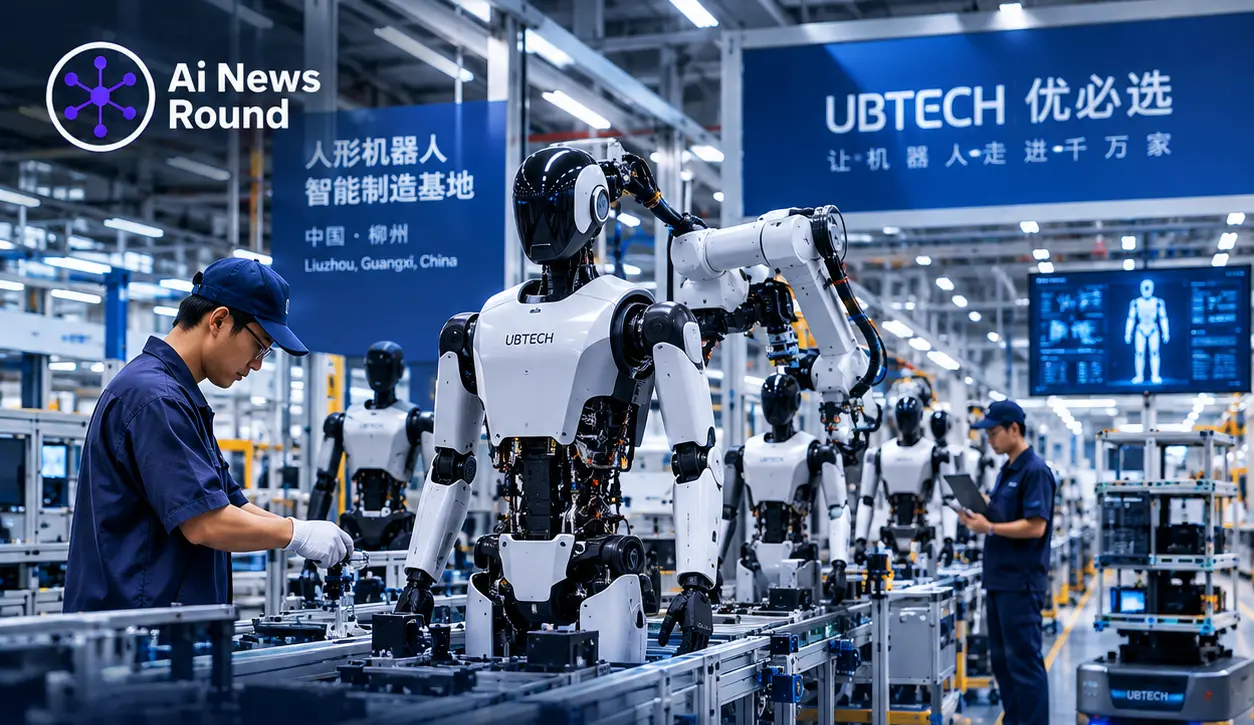
Chinese robotics developer UBTECH has officially commissioned its Industrial Humanoid Robot Super Smart Factory in Liuzhou, Guangxi. Spanning approximately 14,000 square metres with a ceiling clearance height of 13.8 metres, the facility represents a major transition from small batch testing to large scale commercial manufacturing. Designed for a target annual output capacity exceeding 10,000 units, the factory operates on a stated 10-minute takt time, aiming to complete one industrial humanoid platform every ten minutes.
The facility operates a flexible mixed line assembly framework capable of manufacturing both bipedal industrial platforms like the Walker S series and wheeled platforms such as the Cruzr series without requiring rigid overhead conveyor systems or costly line retooling. Before committing physical hardware, UBTECH collaborated with Siemens Digital Industries Software to build a 1:1 digital twin simulation using Siemens Plant Simulation, validating logistics flows and material buffers virtually to reduce on-site debugging delays.
Automated Manufacturing and Quality Control
The operational core of the Liuzhou plant relies on a self automated "robots building robots" manufacturing model. On the factory floor, autonomous mobile robots, self driving forklifts, and Cruzr mobile manipulators equipped with 3D vision handle depalletizing, parts replenishment, and station-to-station component transport alongside human staff.
During final assembly, workpieces ride on self-docking 360-degree rotating workstations paired with collaborative robotic arms to assist human technicians with multi-angle precision joining operations. Because each humanoid requires more than 2,000 fastening operations across roughly 50 screw specifications, an automated torque system logs depth, torque, and angle telemetry into the central manufacturing operations management system to catch fastening errors automatically.
Completed units undergo over four hours of continuous burn-in testing for joint performance, gait, balance, and payload capabilities, followed by multi-angle exterior screening inside an automotive grade lighting tunnel. Finished inventory is then buffered inside a 65-square-metre automated stereoscopic high-bay warehouse capable of holding up to 112 robots. Similar shifts toward autonomous system management were recently covered in our analysis of Perplexity and GPT 6 Astra.