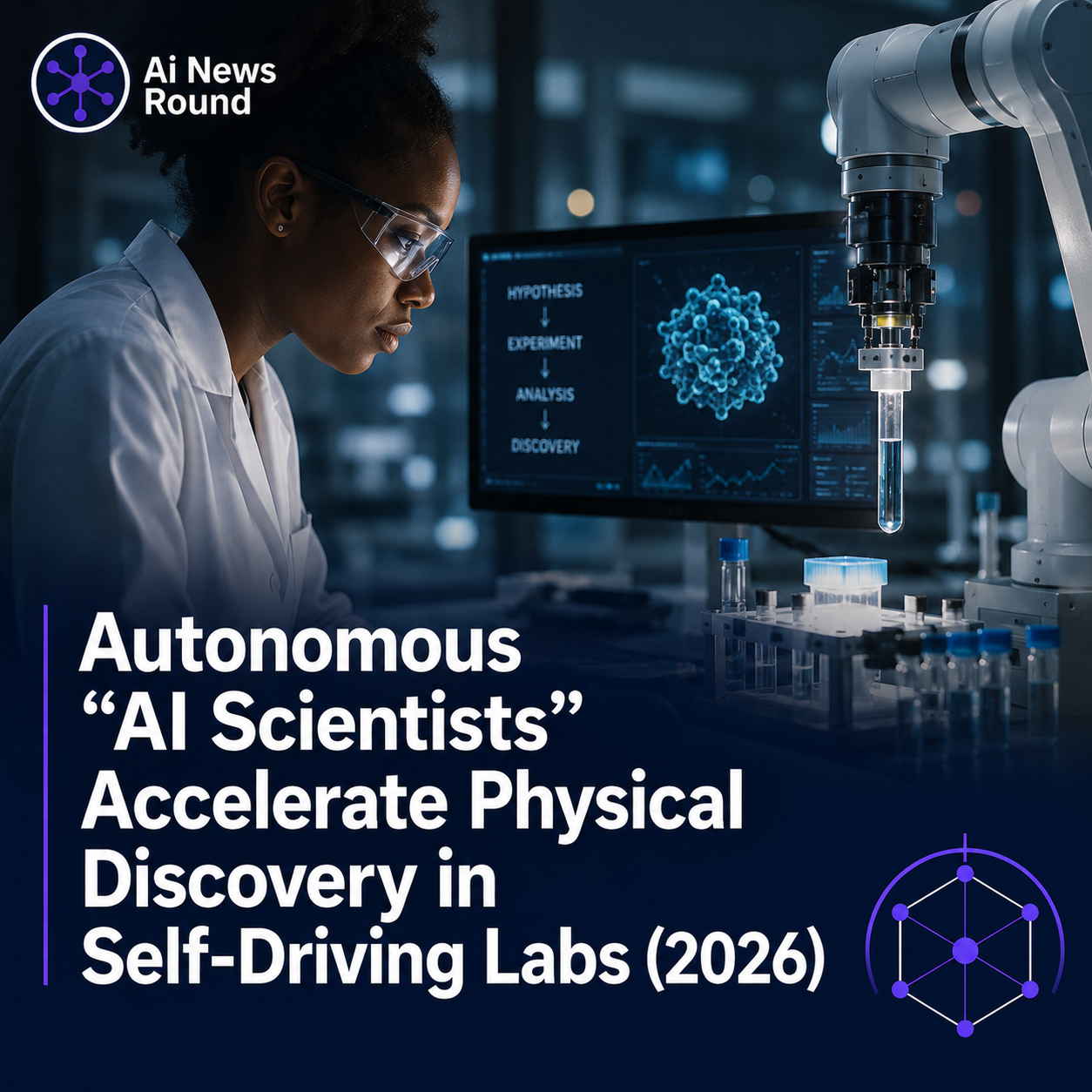
Scientific discovery has reached a historic shift in operational execution. Rather than using artificial intelligence solely as a passive assistant for literature reviews or static data analysis, research institutions are deploying Autonomous AI Scientists—closed-loop systems that manage the entire end-to-end scientific lifecycle.
These agents do not simply generate predictions on paper. They independently formulate hypotheses, write simulation code, operate connected laboratory hardware, and analyze physical outcomes to self-correct their models in real time.
The Rise of Self-Driving Labs
At the core of this trend is the rapid integration of large reasoning models with robotics, often referred to as self-driving laboratories (SDLs). Traditional material discovery operates on years of manual trial-and-error. By putting AI agents in charge of physical laboratory execution, research facilities can run thousands of iterative experiments back-to-back without human intervention.
Key breakthroughs driving this shift include:
Closed-Loop Feedback Cycles: AI algorithms analyze experimental results from physical sensors, update their underlying predictive world models, and generate instructions for the next experiment within minutes.
High-Throughput Material Testing: Advanced robotic arms and automated microplate systems allow autonomous agents to synthesize and evaluate hundreds of chemical formulations per day.
Autonomous Error Correction: When an experiment fails or yields unexpected parameters, the AI scientist adjusts the hypothesis and rewrites experimental parameters automatically rather than waiting for manual intervention.
Research teams at institutions like Argonne National Laboratory and Google DeepMind have already demonstrated the power of this setup. Experiments involving thousands of redox flow battery solvent evaluations that once required five to eight years of manual lab work were completed in under five months.
From Organic Chemistry to Clean Energy
The practical applications of self-driving labs extend across critical industrial sectors. Chemical synthesis labs are using self-verifying agent loops to discover non-toxic semiconductor nanomaterials, higher-density battery storage compounds, and novel catalyst recipes up to ten times faster than conventional methods.
By taking human latency out of the hypothesis-test-learn cycle, the timeline for discovering scalable physical materials is shrinking from decades to weeks.
What It Means for You
For research directors, lab managers, and hardware startups, the emergence of the AI scientist shifts the competitive advantage from manual experimental bandwidth to system design and agent orchestration. Human expertise is moving upstream: scientists set the objectives, boundary conditions, and safety guardrails, while autonomous closed-loop software executes the physical optimization.