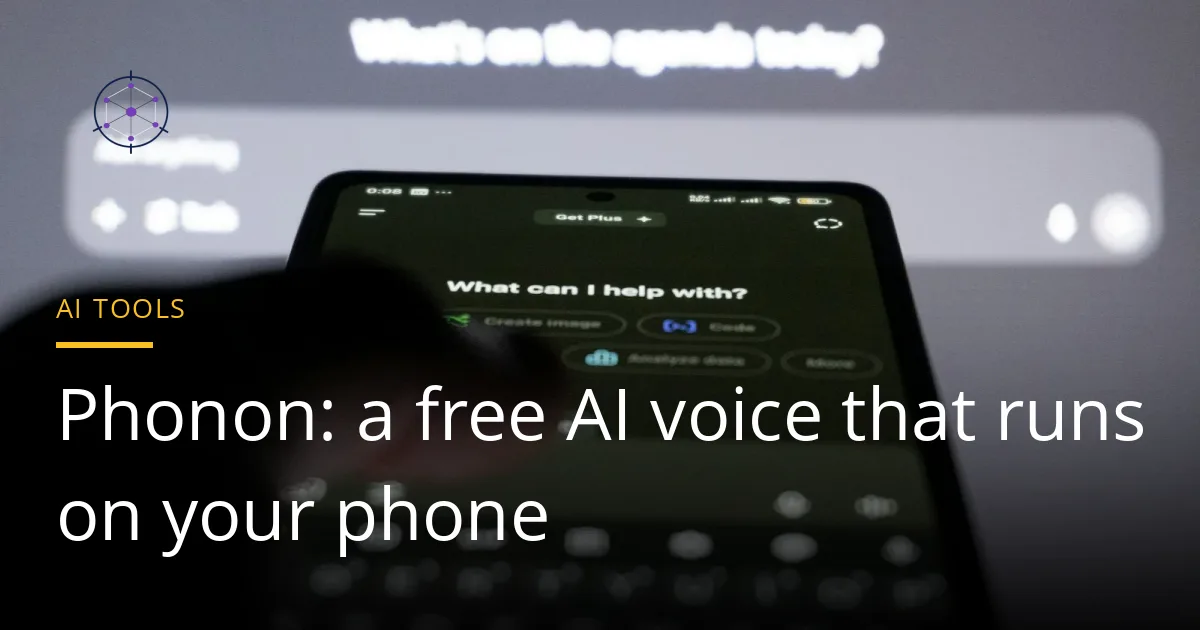
Phonon TTS is a new family of text-to-speech models from Gradium, a Paris voice AI company spun out of the Kyutai research lab. Released this week, the smallest version turns text into natural speech on an ordinary laptop processor, a phone or a Raspberry Pi, with no internet connection and no graphics card. Its English model is free to use, including commercially, under the Apache 2.0 licence.
For developers building voice features in places where data is expensive or connections drop, that combination is the interesting part. Here is what Phonon does, what the numbers say and how to try it.
What Phonon TTS is
Phonon reads text aloud. You give it a sentence and a voice, and it returns audio at 24 kHz. According to its Hugging Face model card, the English model has 31 million parameters, not counting the audio decoder, and the weights file is 64.5 MB in 8-bit form. That is small enough to ship inside a mobile app.
Gradium has published three versions, according to MarkTechPost's write-up of the launch:
- Phonon 31m: English only, Apache 2.0, free for commercial use.
- Phonon 40m: one model per language for English, French, German, Spanish and Portuguese, under a non-commercial CC BY-NC 4.0 licence.
- Phonon 40m multilingual: all five languages in one model, also non-commercial.
The licence split matters. A startup can build a paid English product on the 31m model today. Using the French or Portuguese versions in a commercial app would need a separate arrangement with Gradium.
How fast and how good
All performance figures here come from Gradium's own tests, as reported by MarkTechPost; no independent benchmark has been published yet.
Speed on everyday hardware
- MacBook Air M5, processor only: first audio in 6.9 milliseconds, about 30 times faster than real time.
- Raspberry Pi 5: first audio in 38 milliseconds, 3.7 times faster than real time.
- Snapdragon 8 Elite Gen 5 phone chip: 7.5 milliseconds, 24 times faster than real time.
"Faster than real time" means a ten-second sentence takes well under ten seconds to produce, so the voice can start talking almost as soon as the text arrives.
Quality
Gradium ran listening tests with 1,189 raters casting 17,270 votes. The 31m model scored an Elo of 2098 for US English, ahead of Kokoro (2043) and NeuTTS (2034), two popular open models. On a set of 500 difficult sentences, the model card reports a word error rate of 1.5% when the audio is transcribed back to text. On an easier benchmark Kokoro did slightly better, 0.45% against 0.51%, which MarkTechPost noted.
How to try it
The model card lists several routes, from simplest to most involved:
- Browser demo: a Hugging Face Space lets you type text and hear it, with nothing to install.
- Command line:
uvx ptts --lang en --quant q8 --voice Easton "Hello"writes a WAV file. - Python:
pip install ptts, then call it from your own code, with streaming supported. - Apps and web: packages for npm, Swift, Android, Rust and C/C++, plus a Docker server that mimics the OpenAI speech API, so existing code can switch with a URL change.
The model card points to a voice library of about 100 voices. Cloning your own voice or designing a new one happens in Gradium's paid studio, after which the voice runs locally.
What it means for builders in Africa
Most good AI voices today are cloud services billed per character. That works poorly where mobile data is costly and connections are patchy. An offline model that fits in 65 MB changes the sums for things like reading apps, accessibility tools for people with low vision, talking kiosks and customer-service bots on cheap Android phones.
There are limits. Phonon speaks English well and four European languages under a non-commercial licence, but no African languages. Accents and names common in Lagos, Nairobi or Douala may come out wrong, and the company has not published results for them. For now it is a strong option for English voice features, not a solution for Yoruba, Swahili or Pidgin.
It also joins a busy month for voice AI. Block's research lab released Dessa, a speech model trained only on audio; read our explainer on Block's Dessa.
The bottom line
Phonon is a small, fast, free English voice that runs on hardware people already own. If your product needs speech and you have been paying per character or worrying about connectivity, it is worth an afternoon of testing. Check the licence before shipping anything in French, German, Spanish or Portuguese.