Stripe's $7B OpenRouter Deal, Google's Africa AI Push & Claude's Protein Breakthrough: This Week in AI
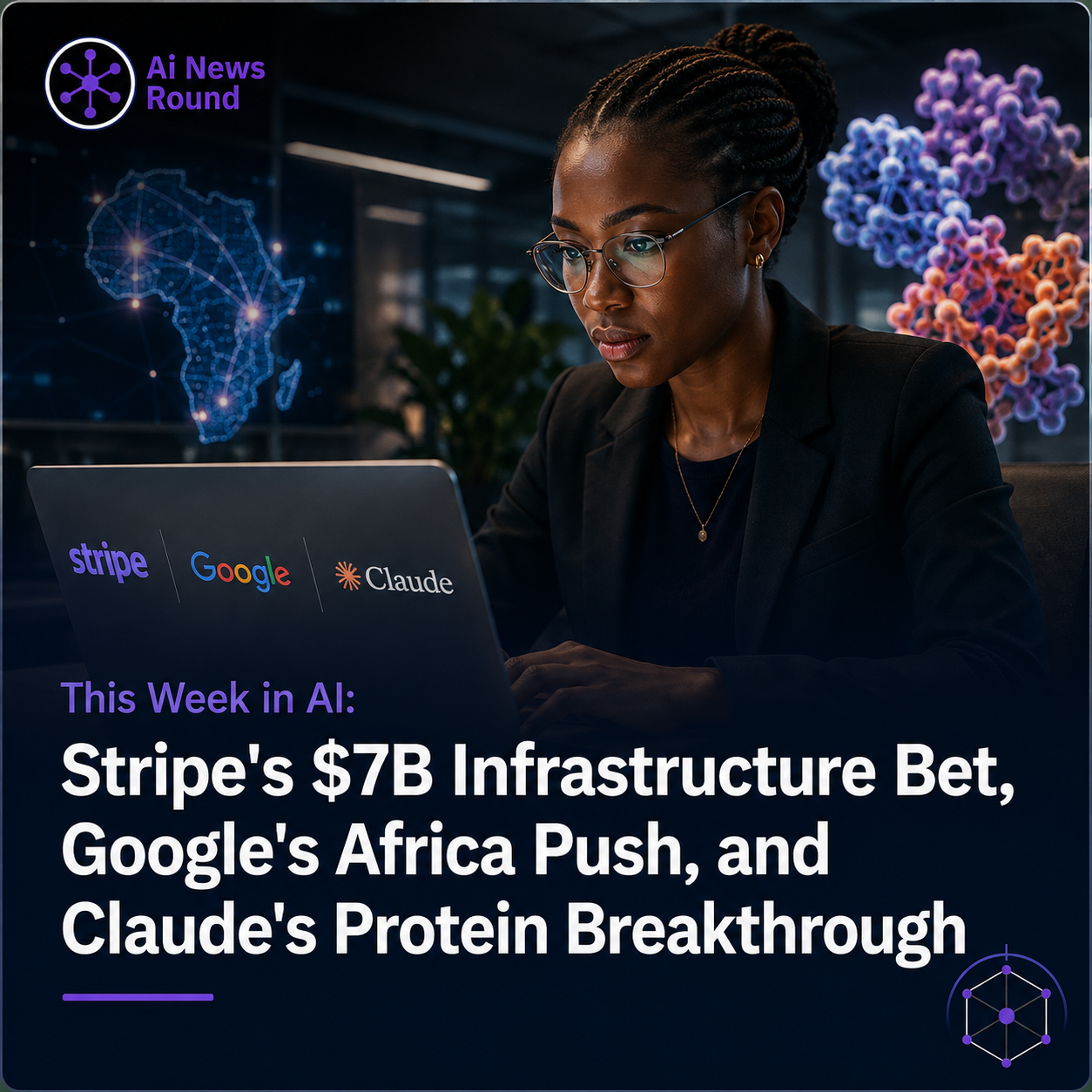
Stripe buys AI gateway OpenRouter for $7B+, Google confirms it has surpassed its $1B Africa investment pledge with a new AI lab and connectivity hub, Anthropic's Claude designs working protein binders at nearly double the industry hit rate, and OpenAI rolls out a safety-first ChatGPT for teens. Here's what matters this week — and what it means for developers and for Africa.
Four stories, one theme: AI infrastructure is consolidating fast — and who gets access to it is becoming the real story.
This week's news cluster is unusually direct in its relevance to African tech ecosystems. Google's confirmation that it has surpassed its $1 billion Africa pledge — paired with live infrastructure like the Johannesburg Cloud region and the new Eastern Cape subsea connectivity hub — signals that African developers and startups now have materially better options for hosting AI workloads closer to home, reducing both latency and data-residency friction. The Africa Applied AI Lab in Ghana is the most immediately actionable item here: founders across the continent have until August 31, 2026 to apply for hands-on access to Google's frontier models.
The Stripe-OpenRouter deal also matters for African builders specifically. Multi-model routing infrastructure — letting a startup switch providers based on cost, latency, or availability without rebuilding its stack — is especially valuable in markets where compute costs and currency volatility make vendor lock-in riskier than in wealthier markets. As this kind of infrastructure consolidates into larger, better-funded platforms, it should, in principle, become more reliable and cheaper to access at scale.
Finally, Anthropic's protein-design results are worth watching for Africa's growing biotech and public-health research community. Autonomous AI-assisted drug and protein design, if it continues to mature at this pace, could eventually lower the cost floor for research into diseases that disproportionately affect the Global South but have historically attracted less commercial R&D investment — though that outcome is still speculative and years away from clinical relevance.
DeepSeek V4.1-Flash-1017 brings higher agent benchmark scores, open weights and a paid Search and Fetch API. Here is what changed and what it costs to use.
Anthropic has leased data center capacity from EverWind at Point Tupper, Nova Scotia, its first Canadian deal, as its compute bill and IPO plans keep growing.
Google has officially released Gemini 4 Argon, the flagship reasoning model of its new Gemini 4 generation. Built for complex, multi-step tasks across software engineering, legal research, and quantitative finance, Argon introduces expanded agentic execution and leads performance on the Vals Index.
2 min read
Get a notification when something new is published.
Done. To stop them later, use the notification settings for this site in your browser.